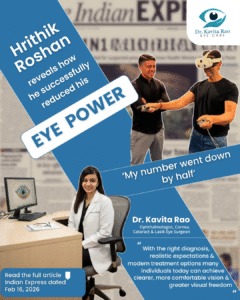
When Bollywood star Hrithik Roshan revealed that his “number went down by half” after an intensive eye‑training programme in Washington, the internet lit up with curiosity. The Indian Express covered the story in detail, and it sparked question millions silently carry: Is it truly possible to reduce your eye power?
Dr Kavita Rao, Consultant Ophthalmologist & Eye Surgeon at P.D. Hinduja Hospital, Khar, Mumbai, helps decode the science behind the headlines — separating inspiration from medical reality.
What Exactly Did Hrithik Roshan Experience?
In his Instagram post, Hrithik shared a humorous yet heartfelt story. At 42, his eye doctor told him bluntly:
“You can’t reverse your number. The eye is not a muscle you can train like in the gym.”
A decade later, after undergoing 4 hours of daily vision training for 5 days in Washington, he claimed his number reduced by half.
This dramatic improvement naturally raised questions — and hopes.
Does Eye Power Really Reduce? What Does Science Say?
Dr Kavita Rao explains that stories like Hrithik’s are inspiring, but they must be understood in the right clinical context.
- Can refractive errors truly reduce in adults?
Conditions like myopia, hyperopia, astigmatism, and presbyopia are linked to the structure of the eye.
These do not usually drop dramatically in adults because:
- The eyeball length does not shrink
- The cornea does not reshape on its own
- The natural ageing of the lens continues
- Then why do some people feel their number has reduced?
Dr Rao explains that many adults experience fluctuating vision, not true reduction in power. This happens due to:
- Convergence insufficiency
- Accommodative spasm
- Digital eye strain
- Dry eye disease
When these issues are treated, the prescription may appear lower — but the structural refractive error hasn’t reversed.
So, What Might Have Happened in Hrithik’s Case?
According to Dr Rao, vision therapy can:
- Improve how both eyes work together
- Reduce focusing stress
- Improve binocular coordination
- Reduce symptoms of early presbyopia
This can make the measured number appear lower, even though the underlying refractive error hasn’t been “cut in half.”
In simple words:
Your eyes may work better, but the eye’s structure hasn’t changed.
Can Eye Exercises or Vision Therapy Replace Glasses?
Vision therapy can help with:
- Eye muscle coordination
- Focusing ability
- Digital strain
- Early presbyopia comfort
But it cannot reverse:
- Myopia progression
- Age‑related lens changes
- Corneal shape issues
This is why expert evaluation is essential before assuming your number has reduced.
What Should You Do If You Want to Reduce Dependence on Glasses?
Dr Kavita Rao recommends a comprehensive eye examination that checks:
- Refraction
- Eye alignment
- Focusing ability
- Corneal health
- Binocular vision
For suitable candidates, modern treatments can safely reduce spectacle dependence:
- Laser vision correction (LASIK, SMILE, PRK)
- Presbyopia‑correcting procedures
- Implantable Collamer Lenses (ICL)
These are medically proven, long‑term solutions — unlike temporary fluctuations caused by strain or spasm.
Why Celebrity Stories Matter — But Need Medical Context
Celebrity experiences, like Hrithik Roshan’s, bring much‑needed attention to eye health. They encourage people to ask questions, get check‑ups, and explore treatment options.
But as Dr Rao emphasises, every eye is unique, and what works for one person may not apply to another.
With the right diagnosis, realistic expectations, and modern technology, many people today can achieve clearer, more comfortable vision — and in some cases, reduce their dependence on glasses safely.